Flora and Fauna: Nature of the Lycian Coast
Explore the rich natural diversity of the region: from pine forests and olive groves to rare animal species and the famous Caretta caretta turtles.
The region from Datça to Kaş, located on Turkey's Turquoise Coast, is the meeting point of the Aegean and Mediterranean seas. This gives it a unique geographical position and contributes to a rich diversity of flora and fauna. Extending from the remote Datça Peninsula in the west to the chic town of Kaş in the east, this area includes major tourist centers like Marmaris and Fethiye, and offers a wide range of natural landscapes—from secluded beaches to mountain villages.
Flora (Plant Life)
The vegetation cover of the Marmaris region, which includes the city center and the Marmaris National Park, is one of the richest in Turkey and is protected. The forests here consist predominantly of Turkish pine (Pinus brutia). In the Marmaris National Park and other protected areas, there are also oak, plane trees, cypresses, wild olive, strawberry tree (Arbutus), sumac, carob (locust), oleander, and laurel.
In the Gökova region, which is also a special protected area, the forests of Turkish pine and sweetgum trees (Liquidambar orientalis) are of high value. Sweetgum trees are an endemic species and are concentrated in specific areas. Locals call the sweetgum "günlük," which gave the name to the Günnücek Bay.
In spring, an abundance of wild herbs is observed in the surroundings of Datça and the Bozburun Peninsula [previous answer]. Almond trees also grow in the Datça region, yielding unique almonds [previous answer]. In general, Gökova is characterized by Mediterranean plants such as olive, red cedar, and almond.
Among the endemic plants of the Marmaris region, the following stand out:
- Onopordum caricum (a species of thistle).
- Globularia dumulosa.
- Cyclamen trochopteranthum.
- Campanula fruticulosa.
- Sage, prickly daisy, and mullein (cow's tail) are also found as endemic species.
- A species of date palm (Phoenix theophrasti), which was previously thought to grow only in Crete, is also mentioned.
In the Fethiye district and along the hiking routes of the Lycian Way, you can see thousands of different flowers. In Kayaköy, the walls of the houses are covered with bougainvillea. In Turunç, there are many pomegranates, mulberries, plums, and Seville oranges, as well as geraniums, oleanders, and bougainvillea.
Fauna (Animal Life)
Mammals: In the Marmaris National Park and the Datça-Bozburun Special Environmental Protection Area, wild goats (Capra aegagrus) live, especially between Marmaris and Köyceğiz. Also found here are bears, foxes, wild boars, red squirrels, weasels, hedgehogs, lynxes, martens, and jackals. In Fethiye, cats are everywhere and are considered "kings"; they are treated with kindness, fed, and cared for. They can be found on park benches, in restaurants, and just lounging wherever they please. The Köşe Kahve Fethiye cafe has friendly neighborhood cats. Dogs are also present, especially in the Çalış Beach area; they are well-fed and usually keep to themselves if not given attention. On one of the beaches during the 12-island tour from Göcek/Fethiye, adorable goats were spotted looking out from the beach and wandering the hills.
Birds: In the Marmaris National Park, a variety of birds are found, including eagles and falcons, as well as migratory birds. In Bördübet Bay, there are many songbirds, and the bay's name comes from the abundance of birds, which British sailors during World War I called "bird's bed." In the bird sanctuary on Çalış Beach (Fethiye), there is a small uninhabited island that is home to 220 bird species. In Lake Ilıca (Ilıca Gölü) in Datça, in addition to fish, ducks are believed to live.
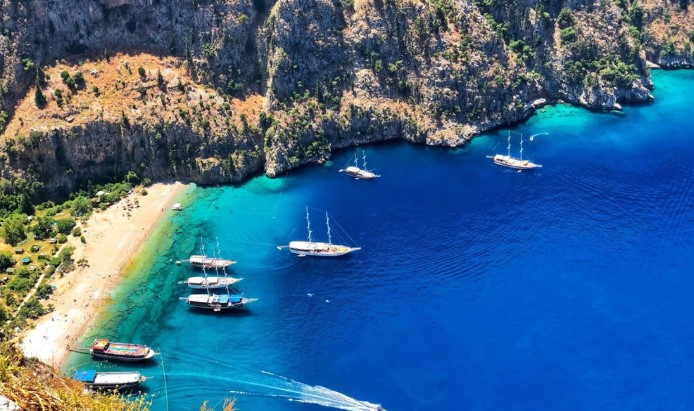
Insects and other invertebrates: Bees (bambus bees / bumblebees) help pollinate plants in the greenhouses of the Gökova region. Butterflies: The Butterfly Valley (Kelebekler Vadisi), located near Ölüdeniz/Fethiye, is named after more than 80 species of butterflies, especially the "Jersey Tiger butterfly" (Euplagia quadripunctaria), which can be seen by the hundreds in June and October. On Fethiye's hiking trails, one can encounter thousands of different flowers and extremely rare butterfly species.
Reptiles (Turtles): Iztuzu Beach (Dalyan, near Marmaris) is an important nesting site for loggerhead sea turtles (Caretta caretta). The beach is closed to visitors from 20:00 to 08:00 during the nesting season (May–October). At one end of the beach is the Sea Turtle Research, Rescue and Rehabilitation Center (DEKAMER). Patara Beach (near Kaş) is also critically important for the survival of the turtles, as they lay their eggs here, and parts of the beach are closed to visitors for their protection. On Çalış Beach, you can also see turtles during the hatching season. In the waters near Ölüdeniz/Fethiye, turtles are often encountered during diving.
Marine Life: The Mediterranean Sea near Marmaris historically had a relatively poor fish diversity compared to the Black Sea, which facilitated trade. However, in Dalyan, a local specialty is the blue crab, which is caught in the river and served grilled. In Marmaris, Çiftlik, Orhaniye, Selimiye, Bozburun, and the Söğüt Saranda area, there are restaurants offering fresh fish, squid, and shrimp. At the Fethiye Fish Market, you can choose fresh fish to be prepared in one of the surrounding restaurants. In Lake Ilıca (Datça), there are fish. When diving in Kaş, there is an opportunity to see turtles and some shipwrecks. It is noted that in the waters of Kaputaş Beach there are no jellyfish or seaweed.
Special Protected Areas:
- Marmaris National Park and the special environmental protection areas of Gökova and Datça-Bozburun cover a significant part of the region.
- Wetlands in the region include the Gökova coast and river systems in Akyaka, Akçapınar, and Gökçe, as well as the Akbük and Hisarönü river systems.
- Butterfly Valley (Kelebekler Vadisi) is officially designated as a natural protected area where residential construction is prohibited.
- Ölüdeniz Blue Lagoon is a national nature reserve.
- Patara Beach is also part of a national park.
- Göcek is a "Registered Special Environmental Protection Area" where high-rise building is prohibited.
This information highlights the rich natural diversity of the region from Datça to Kaş and its surroundings, making it highly attractive for ecotourism and nature lovers.